
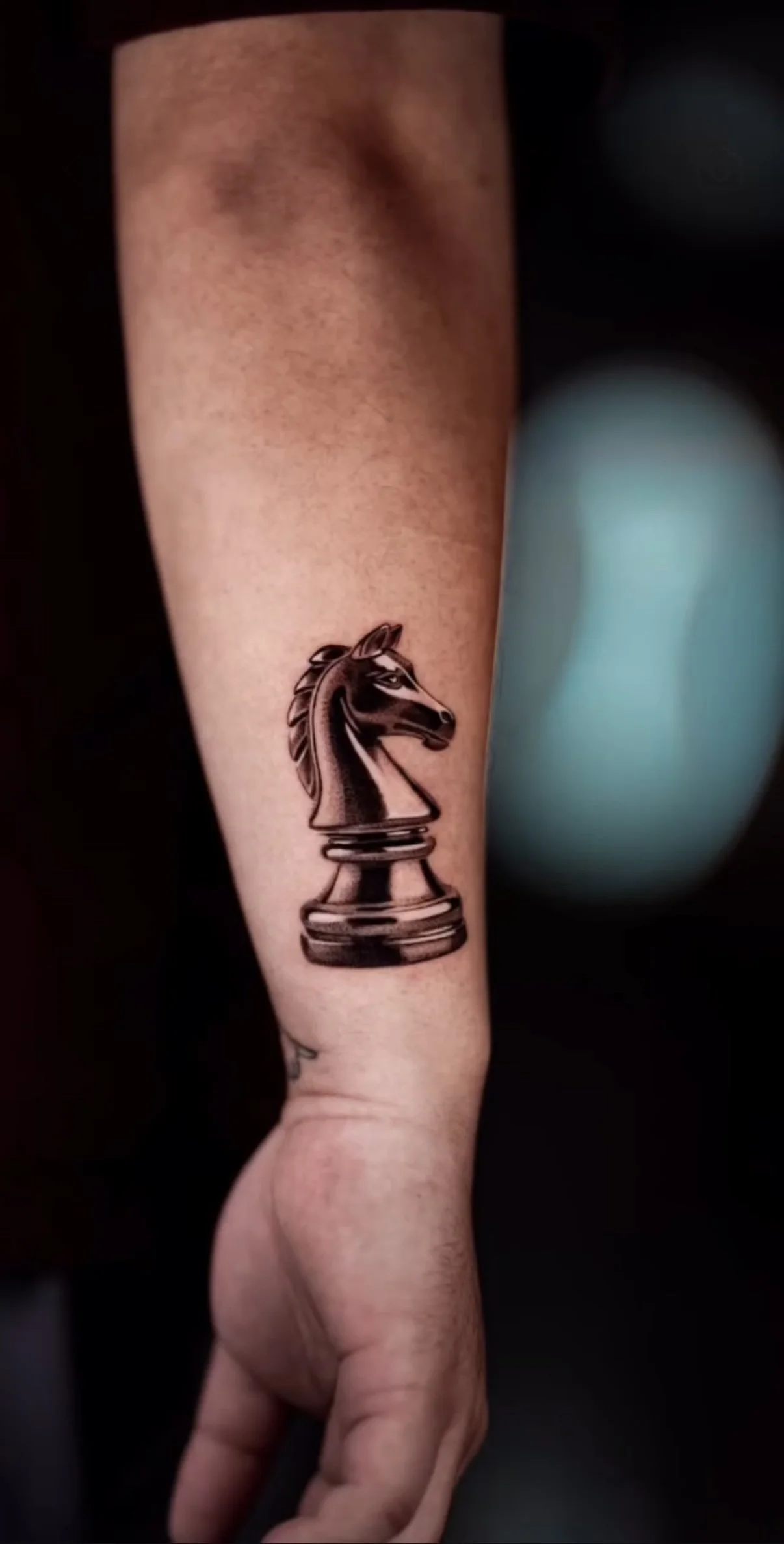
Fine line tattoos have a reputation for being delicate: thin outlines, soft botanicals, small script. That reputation is earned, but it tells only half the story. The same needles that draw a whisper-thin stem can also build shadow, depth, and reflection, one careful pass at a time.
This chess piece tattoo is the proof. Brian Parrillo tattooed it at Ethereal Tattoo Gallery in Durham, NC, as a birthday present for his client. He used only two fine line needles. There are no shading needles anywhere in it. Every highlight, every gradient, and every dark edge came from the same tools artists use for fine linework.
What Makes a Tattoo Needle “Fine Line”?
Tattoo needles are described by three things: the diameter of each needle, how the needles are grouped, and how many sit in the group. This chess piece was tattooed with an 08 3RL and an 08 5RL.
08 is the diameter of each needle, #8 or 0.25 mm. Needles this thin are often called bugpins. They release ink slowly, which gives the artist fine control over every mark.
RL stands for round liner. The needles are soldered tightly into a single point, so they deposit ink in a narrow, precise line.
3 and 5 are how many needles are in each grouping. Fewer needles make a finer mark.
Small, tight round liners like these are the standard tools of fine line tattooing. For a fuller introduction to the style, see What Is Fine Line Tattooing? A Simple Guide for Tattoo Clients. If you are curious how the style developed, A Brief History of Fine Line Tattooing traces its roots.
Fine Line Is a Technique, Not Only a Look
Most people picture fine line as a finished look: light, minimal, and airy. In practice, fine line describes how a tattoo is made. Thin needles, a steady hand, and a light touch in the skin are the foundation. What an artist builds on that foundation can range from a single delicate line to a fully shaded realistic image.
Realistic shading is usually built with wider needles that lay down tone quickly. Building it with fine line needles means layering many thin passes to create each shift from light to dark. It takes longer and leaves less room for error. The reward is precision. Edges stay crisp, small details hold their shape, and the transitions between light and shadow can be controlled down to the smallest step.
That precision is also why fine line work is harder than it looks. There is no bold outline to hide behind. Every line is visible, so every line has to be right.
The Chess Piece, Up Close
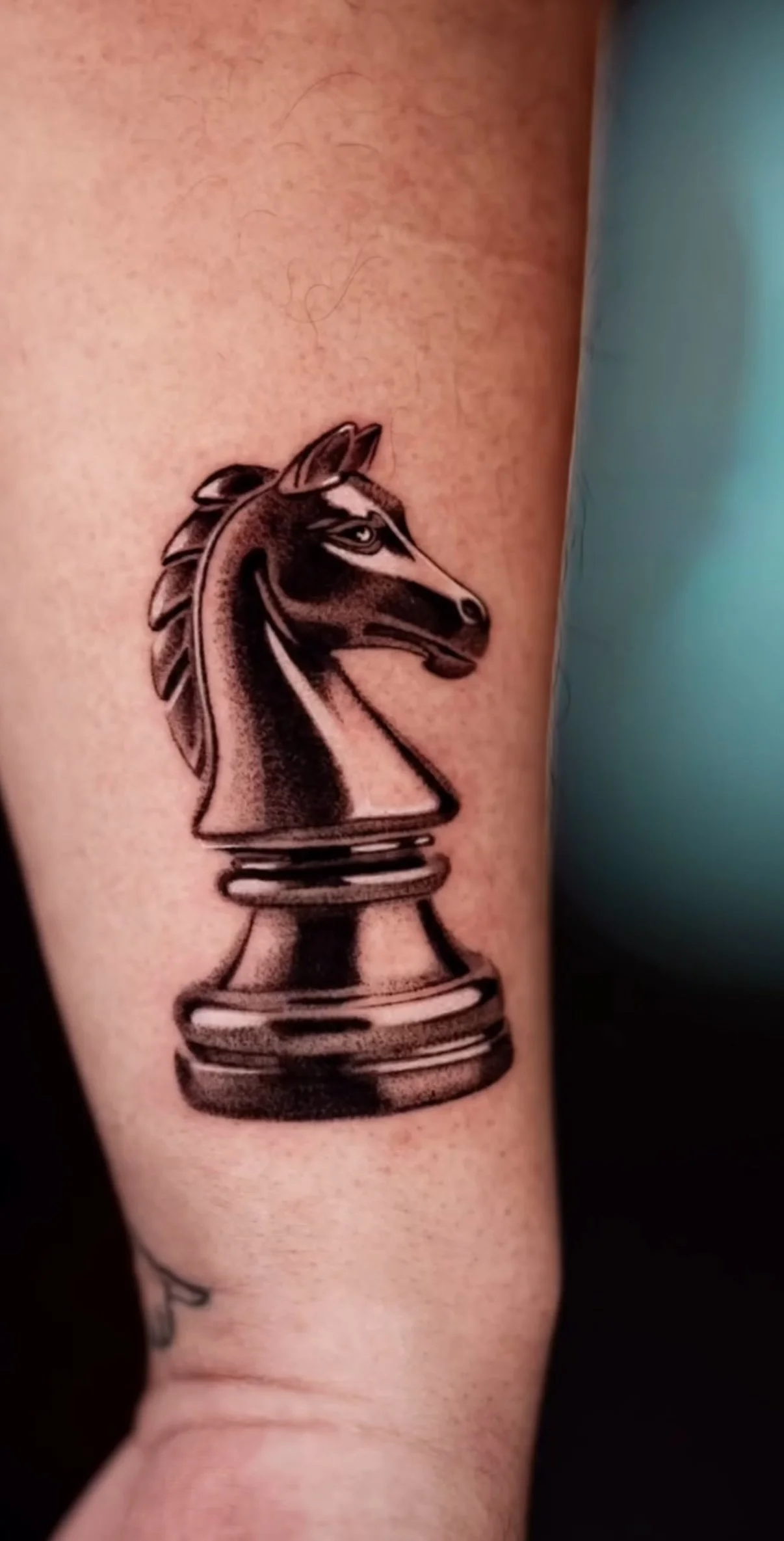
Look at the knight’s head first. The mane is built from fine, directional strokes that follow the carved shape of the piece, so it reads as sculpted rather than drawn. Along the nose and brow, clean highlights are left as open skin, and the darkest values sit right beside them. That tight contrast between light and dark is what makes the surface look polished.
Then look at the base. Each ring of the pedestal catches light differently, with a bright edge on top and a deep shadow beneath. Brian layered those reflections with the same two fine line needles, building each band of tone gradually until the base looked like a solid, glossy object on a chessboard.
The result is a chess piece with a polished, reflective finish, a look that has become one of the most popular tattoo trends right now. Brian, who calls it a chrome chess piece, explains the chrome side of this tattoo on his own blog: Chrome Tattoo Artist in Durham, NC: A Chrome Microrealism Chess Piece.
Brian has been tattooing for more than 12 years, and he is an academically trained fine artist and portrait oil painter. That training in how light falls across a surface is what lets him turn fine line needles into a fully dimensional image. His fine line work has also appeared on Megan Rapinoe.
Why Fine Line Realism Works for Small, Detailed Pieces
Chess pieces are a popular tattoo choice because they carry meaning in a compact shape. A knight, a queen, or a king can stand for strategy, protection, or a person who matters to you, and all of them fit neatly on a forearm, wrist, or ankle.
Small, detailed designs like these are where fine line realism shines. A wide shading needle can blur fine details together at a small scale. Fine line needles keep each detail separate and readable. This chess piece sits on the outer forearm, a placement that gives a small design a clean, flat canvas and keeps it visible.
Do Fine Line Tattoos Last?
All tattoos soften as skin ages, and fine line tattoos show that softening sooner because their lines start out so thin. Placement, sun exposure, and aftercare make a large difference. A well-placed piece by an experienced fine line artist, cared for properly, can stay crisp for years.
Some fine line pieces benefit from a light touch-up after healing. Here is why your fine line tattoo might need a touch-up. For the healing process itself, see Tattoo Healing Week-by-Week: What to Expect and our aftercare instructions.
Fine Line Tattoos at Ethereal Tattoo Gallery
Ethereal Tattoo Gallery has been part of downtown Durham since 2018. The studio is filled with green plants and fine art, a calm place to sit for work that asks for patience. Fine line is at the heart of what we do, and our artists bring it in different directions.
Brian Parrillo brings fine line needles to realism: shaded, dimensional pieces like this chess piece, as well as portraits and other black and grey work.
Yasmin Charalambous creates illustrative and small, detailed fine line tattoos, from botanicals to delicate symbols. See her fine line flower tattoos for examples of her style.
Not sure which direction fits your idea? Our guide on how to choose a fine line tattoo artist in Durham walks through what to look for in a portfolio. Clients travel to us from across North Carolina, including Raleigh, Chapel Hill, and Cary.
Frequently Asked Questions
Can fine line tattoos be realistic?
Yes. Fine line describes the needles and technique, not a limit on detail. With enough skill and patience, an artist can build full realistic shading, depth, and reflection using only fine line needles, as this chess piece shows.
What needles are used for fine line tattoos?
Fine line tattoos are usually done with small round liner needles, such as a 1RL, 3RL, or 5RL. Many fine line artists use thin bugpin needles, around 0.25 mm, for extra control.
Is fine line realism the same as microrealism?
They overlap, but they are not the same. Fine line describes the tools and technique. Microrealism describes realistic detail at a small scale. A tattoo like this chess piece can be both. Learn more in Why Single Needle & Microrealism Tattoos Demand Master-Level Skill.
How much does a fine line tattoo cost?
Pricing depends on size, detail, placement, and the artist. Our fine line tattoo pricing guide explains what affects the cost.
Where can I get a fine line tattoo in Durham, NC?
Ethereal Tattoo Gallery is at 730 Rigsbee Ave in downtown Durham. Our artists specialize in fine line tattoos, from delicate illustrative work to fully shaded fine line realism.
Book Your Fine Line Tattoo
Ready to start your own fine line piece? Request an appointment here. If you would like to work with Brian, note that he is selective about the projects he takes on. Please review his booking criteria before requesting him, so your idea reaches the right artist from the start.